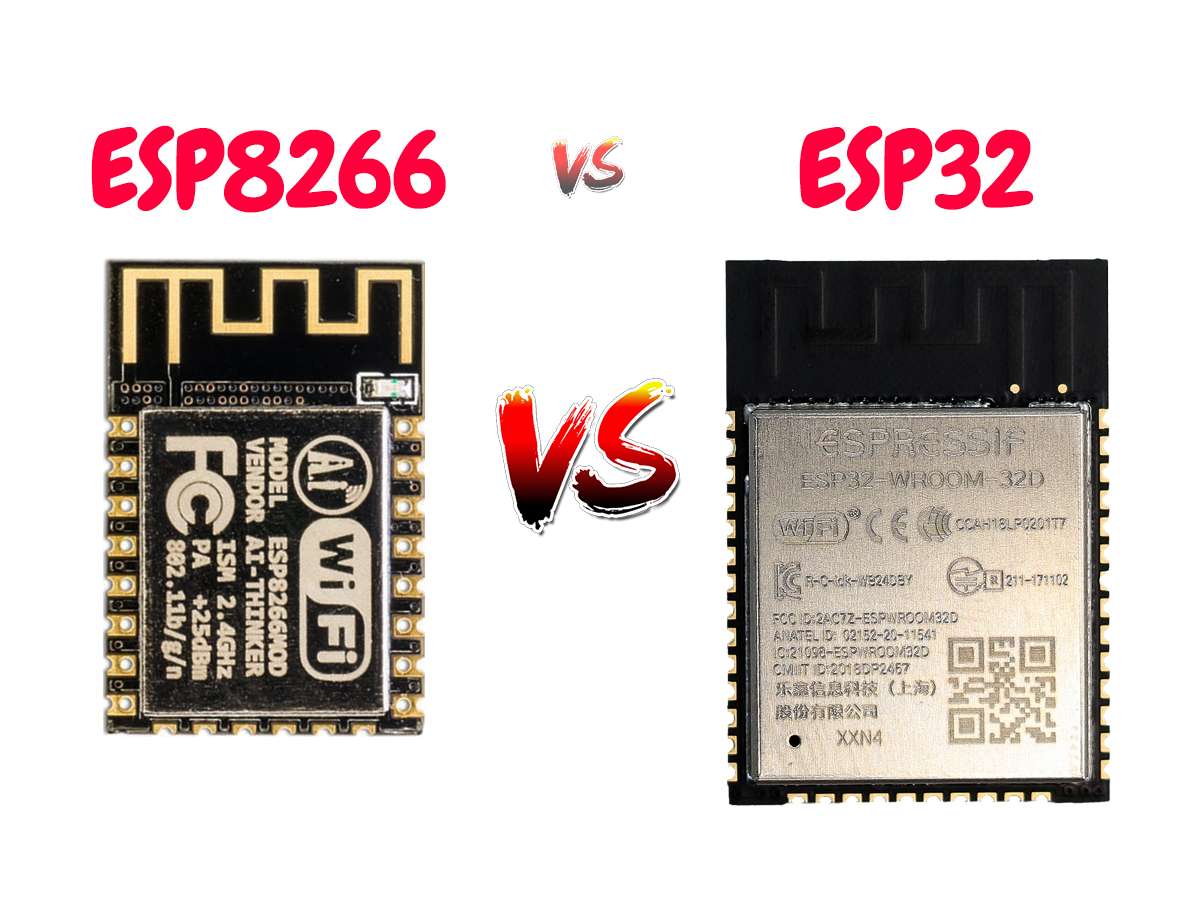
Wireless connectivity has become a standard requirement in modern embedded systems, especially in IoT-focused designs. Among the available solutions, the ESP8266 and ESP32 stand out as two of the most widely used Wi-Fi-enabled microcontrollers. While they share a common origin, their capabilities, performance, and ideal use cases differ significantly. In this article, we will take a closer look at both platforms and compare their technical features to help determine which one is more suitable for a given application.
 Introduction to ESP8266
The ESP8266 is a low-cost Wi-Fi SoC (System-on-Chip) developed by Espressif, widely adopted in IoT applications due to its simplicity and affordability.
Key Characteristics:
- 32-bit Tensilica L106 CPU
- Single-core architecture
- Integrated TCP/IP stack
- External SPI flash required
- Limited peripherals but sufficient for basic applications
Typical Use Cases:
- Smart home devices (switches, plugs)
- Sensor nodes
- Low-cost IoT endpoints
- Wi-Fi-enabled microcontroller replacements
👉 The ESP8266 is best described as:
“A cost-efficient Wi-Fi microcontroller for lightweight embedded applications.”
 Introduction to ESP32
The ESP32 is a significantly more powerful and feature-rich SoC, designed for advanced IoT, embedded systems, and even edge computing applications.
Key Characteristics:
- 32-bit Tensilica LX6 dual-core CPU
- Integrated Wi-Fi + Bluetooth (Classic + BLE)
- Rich peripheral set (ADC, DAC, touch, CAN, etc.)
- Advanced power management
- Hardware security features
Typical Use Cases:
- Industrial IoT (IIoT)
- Wearables and BLE devices
- Audio applications (I2S)
- Real-time control systems
- Edge AI / smart sensing
👉 The ESP32 can be summarized as:
“A high-performance, multi-protocol SoC for complex embedded systems.”
ESP8266 vs ESP32 - Detailed Comparison Table
| Feature | ESP8266 | ESP32 |
|---|---|---|
| CPU | Tensilica L106 | Tensilica LX6 |
| Core Count | 1 | 2 |
| Clock Frequency | 80 / 160 MHz | 160 / 240 MHz |
| Architecture | Harvard | Harvard |
| Wi-Fi | 802.11 b/g/n (2.4 GHz) | 802.11 b/g/n (2.4 GHz) |
| Bluetooth | ❌ Not available | ✅ Classic + BLE |
| SRAM | ~50 KB usable | ~520 KB |
| External Flash Support | Yes | Yes |
| Typical Module Flash Sizes | 512 KB - 4 MB (ESP-01 → ESP-12) | 4 MB - 16 MB (ESP-WROOM / WROVER) |
| GPIO Count | ~17 | Up to 34 |
| ADC | 1 channel (10-bit) | Up to 18 channels (12-bit) |
| DAC | ❌ None | ✅ 2 channels (8-bit) |
| PWM | Software-based | Hardware-based |
| UART | 2 | 3 |
| SPI | 1 | 4 |
| I2C | Software (bit-banged) | Hardware-supported |
| I2S | Basic | Advanced |
| CAN Bus | ❌ No | ✅ Yes |
| Ethernet MAC | ❌ No | ✅ Yes |
| Touch Sensors | ❌ No | ✅ Yes (capacitive) |
| Hall Sensor | ❌ No | ✅ Yes |
| ULP Coprocessor | ❌ No | ✅ Yes |
| RTC Memory | Limited | Available |
| Deep Sleep Current | ~20 µA | ~5-10 µA |
| Active Current | ~170 mA (Wi-Fi TX) | ~240 mA (Wi-Fi TX) |
| Operating Voltage | 3.0 - 3.6 V | 2.2 - 3.6 V |
| GPIO Output Current | ~12 mA | ~40 mA (max) |
| Security | Basic | Secure Boot, Flash Encryption |
| OTA Updates | Yes | Yes |
| RTOS Support | Limited | Native FreeRTOS |
| AI / Edge Capability | ❌ No | ⚠️ Limited (TinyML possible) |
| Cost | Very low | Moderate |
Flash Capacity Breakdown (Module-Level Insight)
ESP8266 Modules
| Module | Flash |
|---|---|
| ESP-01 | 512 KB - 1 MB |
| ESP-07 | 1 MB - 4 MB |
| ESP-12 (E/F) | 4 MB (most common) |
👉 Important note: Flash is always external and connected via SPI.
ESP32 Modules
| Module | Flash |
|---|---|
| ESP-WROOM-32 | 4 MB (standard) |
| ESP-WROVER | 4 MB - 16 MB + PSRAM |
| ESP32-S3 modules | Up to 16 MB |
Some ESP32 variants include:
- PSRAM (Pseudo SRAM) for memory-intensive applications
- Better support for firmware partitioning
Engineering Trade-Off Analysis
When to Choose ESP8266
- Cost-sensitive mass production
- Simple Wi-Fi connectivity
- Minimal GPIO requirements
- Low firmware complexity
👉 Ideal for:
“Basic IoT nodes with tight cost constraints.”
When to Choose ESP32
- Need for Bluetooth (BLE or Classic)
- Multiple peripherals and sensors
- Real-time or multitasking applications
- Higher processing requirements
- Future scalability
👉 Ideal for:
“Scalable, feature-rich embedded systems.”
ESP32 vs ESP8266 Wi-Fi range
When comparing ESP32 vs ESP8266 Wi-Fi range, the answer isn’t just “one is stronger than the other.” It depends on antennas, power settings, and environment—but there are some consistent differences.
Typical Wi-Fi range:
- Indoors: ~30–50 meters
- Outdoors (line of sight): ~80–100 meters
Why:
- Single-core chip, simpler radio
- Usually PCB antenna (smaller, less efficient)
- Lower transmit power compared to ESP32
Strengths:
- Very low cost
- Good enough for small apartments or rooms
Real-World Comparison
| Feature | ESP8266 | ESP32 |
|---|---|---|
| Max range | Short–medium | Medium–long |
| Signal stability | Moderate | Better |
| TX power | Lower | Higher |
| Antenna options | Mostly PCB | PCB + external options |
Pinout comparison between ESP8266 and ESP32
Focusing on the most commonly used development boards (NodeMCU for ESP8266 and ESP32 DevKit).
ESP8266 vs ESP32 Pinout Comparison
| Feature / Pin Type | ESP8266 (NodeMCU) | ESP32 (DevKit) |
|---|---|---|
| GPIO Pins | ~11 usable (GPIO0–GPIO16) | ~25–30 usable (GPIO0–GPIO39) |
| Analog Input (ADC) | 1 pin (A0, 10-bit) | 18 channels (12-bit ADC) |
| DAC (Analog Output) | ❌ None | 2 pins (GPIO25, GPIO26) |
| PWM Pins | Limited (~8 usable) | Almost all GPIOs support PWM |
| UART | 1 full (TX/RX), 1 TX only | 3 UARTs (configurable) |
| SPI | 1 (shared with flash) | 2–4 (VSPI, HSPI available) |
| I2C | Software (any pins) | Hardware + software (any pins) |
| Touch Pins | ❌ None | 10 capacitive touch pins |
| Input-only pins | ❌ None | GPIO34–GPIO39 (input only) |
| Wi-Fi | Yes | Yes |
| Bluetooth | ❌ No | ✅ Classic + BLE |
ESP8266 vs ESP32 Power Consumption
| Mode / State | ESP8266 | ESP32 |
|---|---|---|
| Active (Wi-Fi TX) | ~120–170 mA | ~160–260 mA |
| Active (Wi-Fi RX) | ~50–70 mA | ~80–150 mA |
| Idle (CPU on, no Wi-Fi) | ~15–20 mA | ~20–50 mA |
| Modem Sleep | ~15 mA | ~3–20 mA |
| Light Sleep | ~0.5–2 mA | ~0.8–2 mA |
| Deep Sleep | ~20–100 µA | ~5–20 µA |
| Hibernation | ❌ Not available | ~2–5 µA |
What This Means in Real Life
🔹 ESP8266
- Lower peak power than ESP32
- Simpler sleep modes
- Deep sleep is decent, but not ultra-low
-
Good for:
- Always-on Wi-Fi devices
- Simple IoT sensors
🔹 ESP32
- Higher active consumption (more powerful chip)
- Much better low-power modes
- Can last significantly longer on battery if sleep is used properly
-
Good for:
- Battery-powered projects
- Devices that wake → send data → sleep
Final Decision (Engineer Perspective)
| Scenario | Recommended MCU |
|---|---|
| Ultra-low-cost IoT | ESP8266 |
| BLE + Wi-Fi device | ESP32 |
| Industrial application | ESP32 |
| Simple sensor node | ESP8266 |
| Advanced embedded system | ESP32 |
KEY TAKEAWAY
- ✅ ESP8266 → Minimal, efficient, cost-driven
- ✅ ESP32 → Powerful, flexible, future-proof
GET Quote for ESP items! LINK
| P/N | DESCRIPTION | LINK | |
|---|---|---|---|
 |
ESP-01S(ESP8266) |
The ESP-01S (ESP8266) is a compact and cost-effective Wi-Fi module based on the ESP8266EX SoC developed by Espressif Systems. It integrates a 32-bit Tensilica L106 microcontroller with a full TCP/IP protocol stack, enabling direct Wi-Fi connectivity for embedded systems and IoT applications. |
LINK |
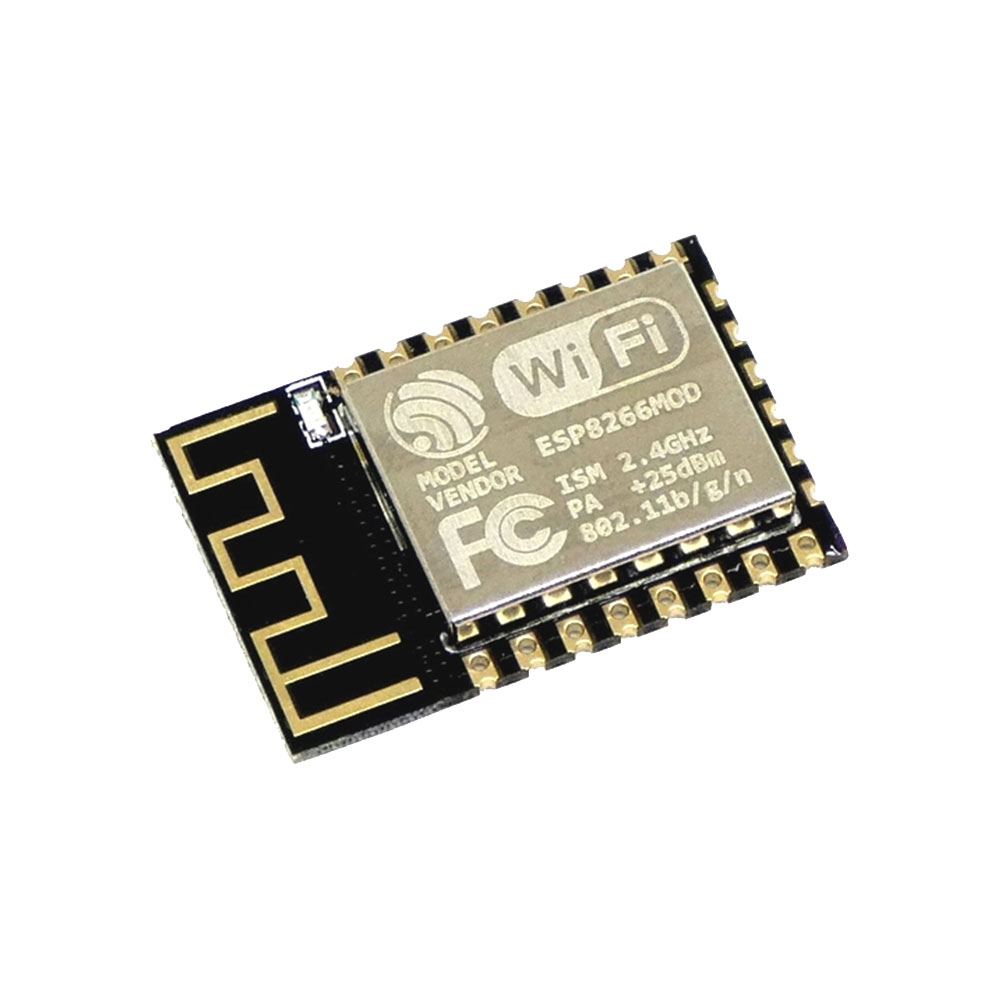 |
ESP8266MOD |
The ESP8266MOD is a highly integrated Wi-Fi module based on the ESP8266 SoC developed by Espressif Systems, designed for cost-effective and low-power wireless connectivity in IoT and embedded applications. It combines a 32-bit Tensilica L106 microcontroller with a full TCP/IP stack, enabling standalone operation or integration with external microcontrollers. |
LINK |
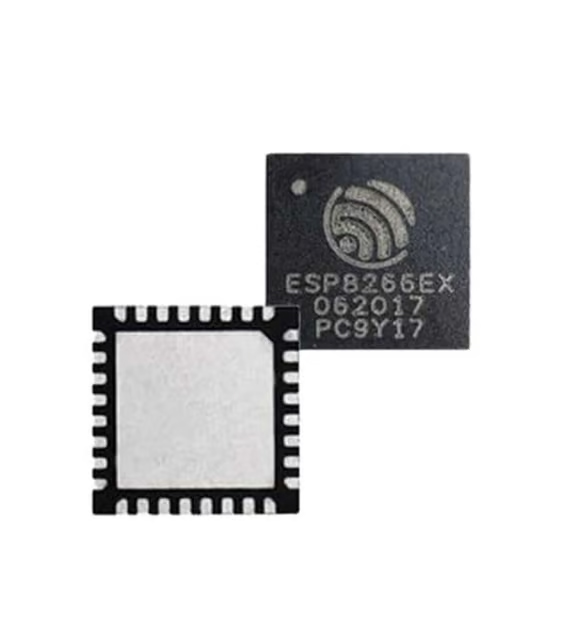 |
ESP8266EX |
The ESP8266EX is a highly integrated Wi-Fi microcontroller system-on-chip (SoC) developed by Espressif Systems for IoT and embedded networking applications. It is built around a 32-bit Tensilica L106 processor running at clock frequencies up to 80 MHz, with an optional overclock to 160 MHz. The device operates with a supply voltage of approximately 3.0–3.6 V and supports external SPI Flash memory for program storage. |
LINK |
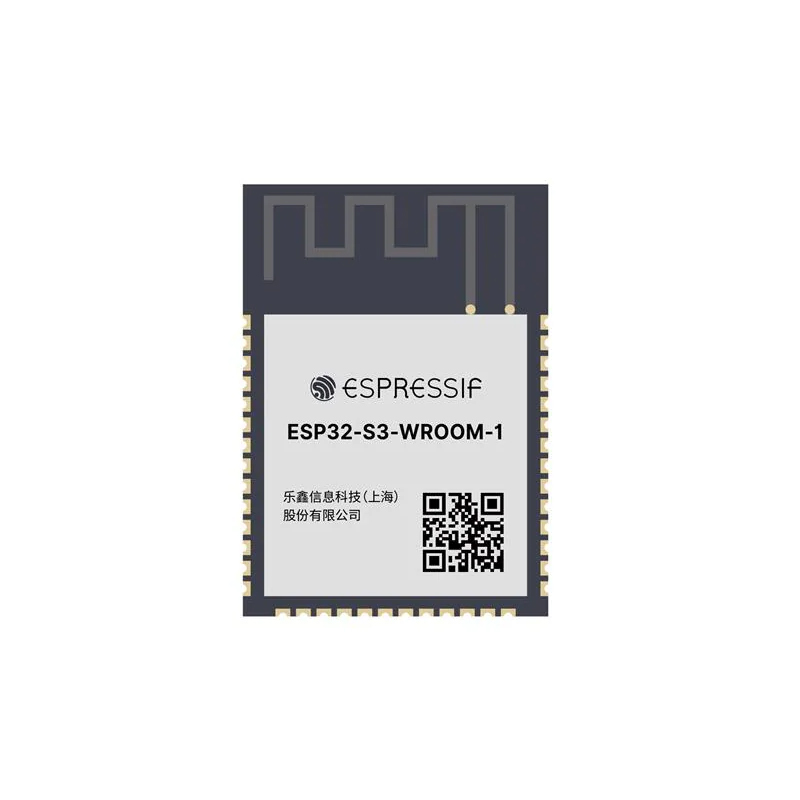 |
ESP32-S3-WROOM-1 |
The ESP32-S3-WROOM-1 is a powerful Wi-Fi and Bluetooth LE MCU module developed by Espressif Systems, built around the ESP32-S3 system-on-chip featuring a dual-core 32-bit Xtensa LX7 processor operating at up to 240 MHz. |
LINK |
 |
ESP32-C3-MINI-1-N4 |
Bluetooth, WiFi 802.11b/g/n, Bluetooth v5.0 Transceiver Module 2.412GHz ~ 2.484GHz PCB Trace Surface Mount, ADC, GPIO, I2C, I2S, JTAG, PWM, SPI, UART, USB, 4MB Flash, 384kB ROM, 400kB SRAM, ESP32-C3FN4, 3V ~ 3.6V, |
LINK |
 |
ESP32-WROVER-E-N16R8 |
Bluetooth, WiFi 802.11b/g/n, Bluetooth v4.2 +EDR Transceiver Module 2.4GHz ~ 2.5GHz PCB Trace Surface Mount, ADC, GPIO, I2C, I2S, JTAG, PCM, SDIO, SPI, UART, ESP32-D0WD-V3, 16MB Flash, 8MB SRAM |
LINK |
 |
ESP32-C3-WROOM-02-N4 |
Bluetooth, WiFi 802.11b/g/n, Bluetooth v5.0 Transceiver Module 2.4GHz PCB Trace Surface Mount |
LINK |
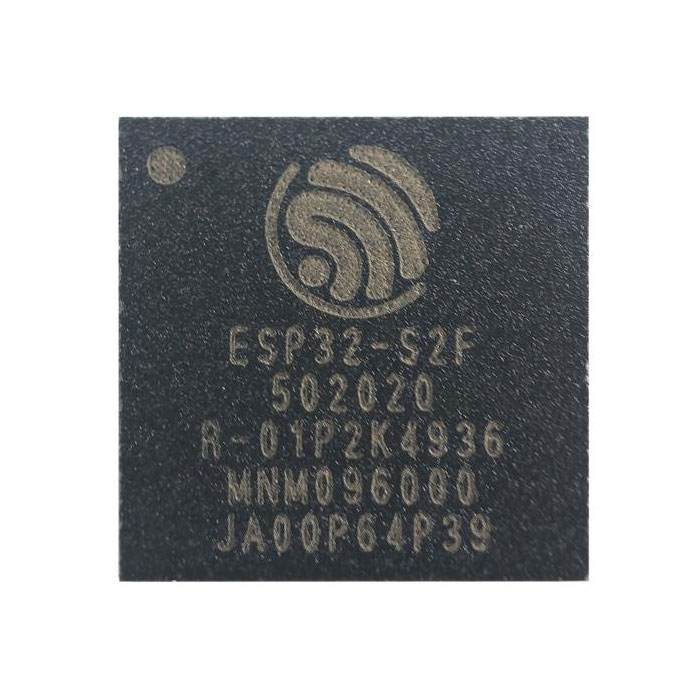 |
ESP32-S2FN4R2 |
WiFi 802.11b/g/n Transceiver Module 2.4GHz Antenna Not Included Surface Mount, ADC, GPIO, I2C, I2S, SPI, PWM, UART, USB, 128kB ROM, 320kB SRAM, 150Mbps |
LINK |
 |
ESP32-WROOM-32E-N4 |
The ESP32-WROOM-32 is a powerful Wi-Fi and Bluetooth MCU module developed by Espressif Systems, designed for a wide range of IoT and embedded applications. It is based on the ESP32 system-on-chip featuring a dual-core 32-bit Xtensa LX6 processor operating at up to 240 MHz. |
LINK |
|
ESP32-C3-WROOM-02-N4 |
Bluetooth, WiFi 802.11b/g/n, Bluetooth v5.0 Transceiver Module 2.4GHz PCB Trace Surface Mount |
LINK |
|
ESP32-WROVER-E-N16R8 |
Bluetooth, WiFi 802.11b/g/n, Bluetooth v4.2 +EDR Transceiver Module 2.4GHz ~ 2.5GHz PCB Trace Surface Mount, ADC, GPIO, I2C, I2S, JTAG, PCM, SDIO, SPI, UART, ESP32-D0WD-V3, 16MB Flash, 8MB SRAM |
LINK |